Thursday, July 4, 2013

Celebrating July 4th, 18th Century Style

By Frank Barker
Assistant Education Coordinator 

1776, The First Independence Day—July 2, 4, 12, 8, 19, 26…?


You know the document. It begins “In Congress, July 4, 1776…”

Independence was declared with signatures and sacred oaths on that day. The date is boldly emblazoned at the top of the Declaration of Independence. Yet in a July 3 letter to his wife Abigail, John Adams wrote, “The Second Day of July 1776, will be the most memorable Epocha, in the History of America. I am apt to believe that it will be celebrated, by succeeding Generations, as the great anniversary Festival…It ought to be solemnized with Pomp and Parade, with Shews, Games, Sports, Guns, Bells, Bonfires and Illuminations from one End of this Continent to the other from this Time forward forever more.”

Adams was right about the celebration part, but missed the date. July 2 was the date Congress approved the Declaration, but July 4 was the date on the document itself, and perhaps the date many of the signatures were affixed.

But that first celebration of the first fourth (or even the first second) was destined to be delayed.
In a world where news traveled only at the speed of a good horse, it took time for the news to travel to Virginia and the other 12 former colonies.


Here is some information from Williamsburg’s Virginia Gazette of that revolutionary summer of 1776.

The postmaster in Fredericksburg writes, of last Wednesday, that, by a gentleman just arrived from Philadelphia, he had seen an Evening Post of the 2d instant, which mentions that the Hon. the Continental Congress had that day declared the United Colonies free and independent states.


From Philadelphia to Fredericksburg to Williamsburg to print in only 10 days. And there is that July 2 date again. This breaking news was so important that the Gazette printed it as soon as they heard, on Friday, July 12, 1776. The article was on page three of that issue, the last piece of news before the classified ads.


One week later, on July 19, an excerpt of the actual Declaration was printed on page two. This was the first part of the document that was a “recapitulation of injuries” with the crown.


The full text of the Declaration of Independence, by order of the Virginia Council, was printed on the following Friday, July 26. Finally, independence was page one news! Later, in that same issue, was this account of the reaction to the public readings of the Declaration.

w i l l i a m s b u r g, July 26.

"...accompanied by the firing of cannon and musketry..."
Courtesy of Frank Barker
Yesterday afternoon, agreeable to an order of the Hon. Privy Council, the declaration of independence was solemnly proclaimed at the Capitol, the Courthouse, and the Palace amidst the acclamations of the people, accompanied by firing of cannon and musketry, the several regiments of continental troops having been paraded on that solemnity.


And from New Jersey:

t r e n t o n, July 8.

The Declaration of Independence was this day proclaimed here….the Declaration and other proceedings were received with loud acclamations.


In New York:

On Wednesday last the Declaration of Independence was read at the head of each brigade of the continental army posted at and near New York, and every where received with loud huzzas and the utmost demonstrations of joy.

The same evening the equestrian statue of George III, which Tory pride and folly raised in the year 1770, was, by the sons of freedom, laid prostrate in the dirt, the just desert of an ungrateful tyrant!


A contemporary illustration of the destruction of the King George statue
in New York.  Apparently, the illustrator had not actually seen the statue,
as he left out an important detail; King George was on a horse.  That statue,
and its destruction, have a story all their own.  Check it out here


Our first Independence Day. It wasn’t on July 4. There were no fireworks, no hot dogs, but there were cannons, musketry, parades, and huzzas. And the destruction of a statue destined to be melted down for 42,088 musket balls.


1777, the Second Independence Day—Finally, July 4!


The Nation’s Capital, Philadelphia, had probably the most elaborate celebration in the United States, documented well in the Virginia Gazette of July 18, 1777.

Here is a time line of the events as reported.

p h i l a d e l p h i a,  July 5

Yesterday the 4th of July, being the Anniversary of the Independence of the United States of America, was celebrated in this city with demonstration of joy and festivity.

  • About noon all the armed ships and gallies in the river were drawn up before the city, dressed in the gayest manner, with the colours of the United States and streamers displayed.
  • At one o'clock, … they began the celebration of the day by a discharge of thirteen cannon from each of the ships, …in honour of the Thirteen United States.
  • In the afternoon an elegant dinner was prepared for Congress, to which were invited the President and Supreme Executive Council, and Speaker of the Assembly of this State, the General Officers and Colonels of the army, and strangers of eminence, and the members of the several Continental Boards in town.
  • The Hessian band of music taken in Trenton the 26th of December last, attended and heightened the festivity with some fine performances suited to the joyous occasion…. [They couldn’t get an American band for the event? Did the Beach Boys have another gig?]
  • After dinner a number of toasts were drank, all breaking independence, and a generous love of liberty….
  • Each toast was followed by a discharge of artillery and small arms, and a suitable piece of music by the Hessian band.
  • The glorious fourth of July was reiterated three times accompanied with triple discharges of cannon and small arms, and loud huzzas that resounded from street to street through the city.
  • Towards evening several troops of horse, a corps of artillery, and a brigade of North Carolina forces, which was in town on its way to join the grand army, were drawn up in Second street and reviewed by Congress and the General Officers.
  •  The evening was closed with the ringing of bells…
  • …and at night there was a grand exhibition of fireworks, which began and concluded with thirteen rockets on the commons, and the city was beautifully illuminated.”
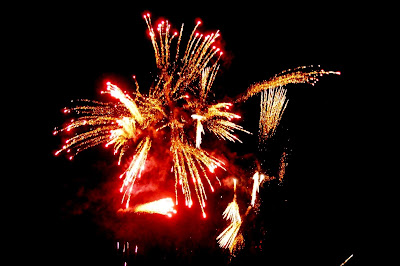
    "...And at night there was a grand exhibition of fireworks..."
So by the first anniversary of the Declaration of Independence, July 4 customs were established for all time, flag-waving, a cookout, patriotic music, drinking, shouting, a parade, fireworks, and bell-ringing. It sounds familiar, doesn’t it? Downright American.


Sources

“Adams Electronic Archive : Letter from John Adams to Abigail Adams , 3 July 1776 , ‘Had a Declaration...’” Adams Electronic Archive : Letter from John Adams to Abigail Adams , 3 July 1776 , “Had a Declaration...” N.p., n.d. Web. 18 June 2013.

"Virginia Gazette, Dixon and Hunter, July 18, 1777, Page 2." Virginia Gazette. Williamsburg. Web. 27 June 2013.

"Virginia Gazette, Purdie, July 12, 1776, Page 3." Virginia Gazette. Williamsburg. Web. 27 June 2013.

"Virginia Gazette, Purdie, July 19, 1776, Page 2." Virginia Gazette. Williamsburg.  Web. 27 June 2013.

"Virginia Gazette, Purdie, July 26, 1776, Page 2." Virginia Gazette. Williamsburg.  Web. 27 June 2013.

Thursday, June 27, 2013

A Lost Mason Burying Ground Has Been Found

By Dave Shonyo
Staff Archaeologist
Within easy view of the Gunston Hall mansion there stands a point of land high above the coastal plain. In George Mason’s time, when the slope was not covered with trees, the point would have offered a splendid view of the Potomac and the majority of the plantation’s agricultural lands. It was here that Mason established his family burying ground.
The first occupants of the burying ground were James and Richard Mason, the prematurely-born twin sons of George and Ann. The boys were born and died in December 1772. In March 1773 their mother, Ann, followed them to the burying ground.
This was not the first time that death in his immediate family had stricken George Mason. In 1757, while Gunston Hall was still under construction, he lost his fifteen-month-old son William. Mason recorded the death in the margin of his family Bible, noting that William “…was buried at the Family Burying Place at Newtown.” Newtown was the plantation established by Mason ’s Grandfather, George Mason II. The site of the Newtown house is about 1,500 feet north of the Gunston Hall mansion, in what is presently a much overgrown, wooded area.
 In the early 1890’s, Kate Mason Rowland visited Gunston Hall for the purpose of gathering material for several magazine articles and a two-volume biography of Mason. In the latter she wrote, “ ‘New Town’…has passed away utterly; the very name of it is unknown in the neighborhood today. And recent owners of the land have ruthlessly ploughed up the old graveyard, one of the old tombstones having been left leaning against a tree in one of the fields.” 


Dennis Johnson uses ground penetrating radar to help
pinpoint the location of the Newtown burying ground.  He
was able to map 15 gravesites.  (Photo by Patrick Ladden.)
 It is not clear whether Rowland actually knew where the Newtown burying ground was located. However, at least since the time of her visit, it has been lost - first under a plowed field and then under a forest that replaced the field.

Newtown has a claim to fame in addition to being one of the earliest historic sites in Fairfax County: it is the probable birthplace of George Mason. For this reason there is interest in making the site suitable for interpretation to the public. To that end, we have begun clearing part of the Newtown area and examining it from an archaeological perspective.
While conducting a surface reconnaissance, Paul Inashima, an archaeological consultant to Gunston Hall, made an intriguing discovery. Amongst the brambles and other forest undergrowth, about 250 feet south of the Newtown house site, lay two shallow depressions in the earth. They were side by side and just about the size and shape one would expect of graves. Could these be part of the long lost burying ground?
Paul and Gary Knipling, a Gunston Hall neighbor and advocate, proceeded to clear about 6,000 square feet of area around the depressions of all but the largest trees. Dennis Johnson, former President of Geophysical  Survey Systems, Inc., brought in some ground penetrating radar (GPR) equipment that he helped develop. The results of the radar survey are shown in the accompanying diagram.
The fifteen graves indicated by the radar survey are all aligned in the same direction and are arranged in rows of varying lengths. There can be little doubt that this is the Newtown burying ground. But, who are all of these people?

The graves detected during the ground penetrating radar survey are shown as
blue rectangles.  The red arrows indicate the depressions that first suggested
that this was the location of the Newtown burying ground.  The green circles
are large trees.  (Image by Dennis Johnson and Paul Inashima.)
Only one burial is known to be documented, and that is the infant William. Mason referred to this as a family burying place, which strongly suggests that other Masons and Mason kin preceded William here. There is some, rather tenuous, evidence that Mason’s father was buried here after his drowning death in 1735. And, if that is the case, is seems reasonable to surmise that Mason’s mother would have been brought here after her death at Chopawamsic in 1762.
Jeremiah Bronaugh leased Newtown from 1731 until his death in 1749. His tombstone currently resides at Pohick Church, but Jeremiah does not. It is likely that this is the tombstone that Rowland saw leaning against the tree during her visit. This would make Bronaugh another candidate for a Newtown burying ground occupant. Bronaugh’s wife, Simpha Rosa Ann Field Mason Bronaugh was a maternal aunt of George Mason and was living at Gunston Hall at the time of her death in 1761. It is quite probable that she was buried with her husband at Newtown.
Finally, Thompson Mason, the brother of George, requested in his will that his sons remove the body of his first wife, Mary, from Gunston Hall and reinter her at his home at Raspberry Plain. Mary died in October 1771, before the present family burying ground was established at Gunston Hall. So, Mary King Barns Mason was probably buried at Newtown. Whether her body was relocated to Raspberry Plain as requested is not known.
That leaves at least nine graves with unknown occupants. The number may grow yet larger because it is planned to survey an additional area adjacent to that already completed. In any case, the last resting places of a group of people who pioneered the settlement and development of this area have now been recovered from oblivion.


Thursday, June 20, 2013

George Mason's Children

By Lacey Villiva
Education Manager

During much of George Mason’s life, Gunston Hall must have rung with activity and childhood antics.  He and his first wife, Ann Eilbeck, had 12 children.  Though by turns there was also a fair amount of tragedy in the family.  Of the 12 only nine survived to adulthood.  Their third child William did not make it out of infancy.  The last two, a set of twins named Richard and James, and their mother all died in a very close time frame.  The two boys only lived for a day, and Ann Eilbeck Mason died in March of 1773.  Most of the rest of the children lived fairly long lives, married and had children of their own, producing a total of 59 grandchildren, 24 of whom George Mason saw before his death in 1792.


George Mason V of Lexington c.1780-1790.
Property of Gunston Hall.
The eldest of those was George Mason V.  George, as eldest son, inherited the bulk of George Mason IV’s estate upon his death in 1792, including his “Mansion house and Seat at Gunston Hall.”  At the time, George was living at Lexington, the plantation Mason had given him in 1774.  Like his father, he was a patriot, and commanded a militia company to Hampton in 1776.  Thereafter he went to France, working with his father’s business, and stayed there from 1779 to 1783.  He had married Elizabeth Mary Ann Barnes Hooe in 1784 and continued the family line in the person of George Mason VI.  They almost certainly continued to live at Lexington until George Mason V’s death in 1796, only four years after his father.

Mason’s second child, Ann (Nancy) Eilbeck Mason, took up the mantle of hostess after the death of her mother in 1773, at age 18.  She married late in life, after all her sisters, at age 34 to Rinaldo Johnson.  Johnson, by signing as guarantor for a Prince George’s County tax collector, was in massive debt to the state of Maryland at their marriage.  Mason developed a marriage contract for their union to protect his daughter’s livelihood.  They lived near Baltimore, MD, and had three children.  She died in 1814.
 As was common in the 18th century when a child died, their name was reused and given to the next child of the same gender.  The Masons’ fourth child was named William following the death of his brother in 1757. He, like his older brother, fought in the American Revolution.  In 1780, Mason recalled him, writing to Light Horse Harry Lee that he had “ever intended him for civil and private life; his lot must be that of a farmer and gentleman.”  William inherited Mattawoman, a property in Charles County, MD from his maternal grandmother.  In 1793, he married Ann Stuart, with whom he had five children.  He lived to age 61 and died in 1818.

The fifth child was Thomson Mason, who like his brothers participated in the American Revolution, though by 1783 he had returned to a private life.  He was manager of his brother George’s estates during his time in France, and resided at Gunston Hall until the completion of his home, Hollin Hall on Little Hunting Creek in 1787.  He married Sarah McCarty Chichester, and their first two children, Thomson Francis and George William, were born at Gunston Hall.

In 1760, the Mason’s welcomed their second daughter, Sarah Eilbeck.  She was the first of the Mason children to marry, in 1778 at the age of 18 to Daniel McCarty, Jr.  They had a number of children together, one of whom was John Mason McCarty.  The younger McCarty had the misfortune to become involved in a philosophical disagreement over his eligibility to vote in 1817.  The argument happened between himself and his second cousin, General Armistead Thomson Mason.  After multiple escalations and discussions that both men needed to no longer be of this earth, the gentlemen finally agreed to a duel at 12 feet with muskets.  The duel took place in February, and McCarty braved the cold without his coat.  Mason, however, kept his on, which proved to be his downfall as his firearm got tangled in his coat.  McCarty’s ball split into three pieces and killed Mason instantly, though not before he got off a shot.  Mason’s round went into McCarty’s wrist and traveled up his arm to his shoulder.  McCarty was described thereafter as being a changed man until his death in 1852.

Mary Thomson, the Mason’s third daughter and seventh child, was born in 1762.  She appears to have made the biggest impression on the children’s stepmother, Sarah Brent, as she was willed a mourning ring for George Mason IV.  She married John Travers Cooke in 1784.  It is possible they came together through family connections, as Cooke’s stepfather was George Mason IV’s cousin.

John Mason, c. 1830. Property of Gunston Hall.
The Masons’ eighth child was John Mason, important to us today because of a significant document he left behind.  At the end of his life, John Mason penned his Recollections, which is the best surviving description of the house and grounds at Gunston Hall.  It also gives the reader a peek into the character and demeanor of George Mason IV.  Too young to participate in the Revolution as had his older brothers, John Mason was sent to school in Calvert County, MD.  In 1788, John Mason entered a partnership with merchants James and Joseph Fenwick, which also resulted in his operating the business in France through the French Revolution.  Upon his return, John Mason established a branch of the firm in Georgetown.  After his marriage in 1797, he settled in that area, as well as constructing a summer residence on Analoston Island, now Theodore Roosevelt Island.  John Mason was the longest surviving Mason child; he passed away in 1849.

Elizabeth, the Masons’ ninth child, was born in 1768, and it is unclear when she died.  At age 21 she married William Thornton, who served as a representative to the Virginia House of Delegates, and in the 1788 Ratifying Convention.  According to her older brother John, they lived in a house called The Cottage in King George County, VA.

The youngest surviving Mason child was Thomas.  He was born in 1770.  Like John Mason, he was too young to fight in the Revolution, and was both tutored at home, as well as sent off to the Fredericksburg Academy.  George Mason IV obtained an apprenticeship with a merchant in Richmond, but worried about his “Fickleness of Disposition,” and considered sending him to work with John in France.  In 1793, Thomas married Sarah Barnes Hooe, the sister of George Mason V’s wife.  By 1795 he was residing on a plantation called Woodbridge, named after the toll bridge he had undertaken to construct over the Occoquan River.  The area still carries that name today.  Thomas Mason died in 1800 while serving on the Virginia House of Delegates.

For more information on the Mason Family, please visit our website.

Sources:
Copeland, Pamela C. and Richard K. MacMaster, The Five George Masons: Patriots and Planters of Virginia and Maryland. University of Virginia Press: Charlottesville, VA, 1975.
McCarty, Clara S. Duels in Virginia and Nearby Bladensburg. Dietz Press: Richmond, VA, 1975.
Rutland, Robert A. The Papers of George Mason, 1725-1778. University of North Carolina Press: Chapel Hill, NC, 1970. 

Thursday, June 13, 2013

The Virginia Declaration of Rights

By Mark Whatford
Deputy Director

In his draft of the Virginia Declaration of Rights (VDR), Mason wrote that "all men are born equally free and independant [sic], and have certain inherent natural rights,...among which are the Enjoyment of Life and Liberty, with the Means of acquiring and possessing Property, and pursueing [sic] and obtaining Happiness and Safety." This was a call for American independence from Britain, in May of 1776. The Virginia Convention Ratified the VDR on June 12, 1776.

This uniquely influential document was also used by James Madison in drawing up the Bill of Rights (1789) and the Marquis de Lafayette in drafting the French Declaration of the Rights of Man (1789).


A Manuscript draft of the Declaration of rights, this section discusses the
importance of freedom of the press. Courtsey of the Library of Congress.
On May 15, 1776, the Virginia Convention "resolved unanimously that the delegates appointed to represent this colony in General Congress be instructed to propose to that respectable body to declare the United Colonies free and independent states . . . [and] that a committee be appointed to prepare a DECLARATION OF RIGHTS and . . . plan of government." Richard Henry Lee's resolution of June 7, 1776, during the Second Continental Congress, Lee put forth the motion to the Continental Congress to declare Independence from Great Britain, which read in part:
Resolved: That these United Colonies are, and of right ought to be, free and independent States, that they are absolved from all allegiance to the British Crown, and that all political connection between them and the State of Great Britain is, and ought to be, totally dissolved.

This implemented the first of these Virginia Convention resolutions and precipitated the appointment of the committee to draw up the Declaration of Independence; the second proposal was carried out by the framing of Virginia's first state constitution, of which the VDR was an integral part.
As passed, the Virginia Declaration was largely the work of George Mason; the committee and the Convention members [among them being Thomas Ludwell Lee, Patrick Henry & Edmund Pendleton] made some verbal changes and added Sections 10 and 14. This declaration served as a model for bills of rights in several other state constitutions.

An early draft of the VDR was published in the Virginia Gazette June 1, 1776, and later in several Pennsylvania newspapers. It was republished in the Maryland Gazette on June 13th, as it was all over the American Colonies. The Pennsylvania newspapers carried a Williamsburg date line of June 1, 1776. For some unexplainable reason the Maryland Gazette date line was "Williamsburg May 24, 1776." The June 12th official Declaration was apparently not published beyond Virginia. The various state conventions and assemblies, and the Declaration of Independence committee copied from the June 1st draft as published in the papers.

Alexander Purdie, a publisher of the Virginia Gazette, added a postscript to
the June 14 edition of the newspaper which included the ratification
date of June 12, 1776.  Courtesy of Colonial Williamsburg.

John Adams added some clarification of the VDRs influence on the Declaration of Independence in his Diary on June 23, 1779 when he revealed that the Virginia Declaration of Rights "made by Mr. Mason" had been published in Philadelphia before he, Franklin and Jefferson prepared the Declaration of Independence, and that Pennsylvania copied it "almost verbatim." Adams did the very same thing for Massachusetts within the year in which that entry was made in his Diary. Both the Declaration of Rights of Pennsylvania and that written by Adams for Massachusetts, and those of many other states use Mason's original words: "That all men are born equally free and independent" etc.

Ray Raphael, author of the book Founding Myths, said of the VDR:
“In fact, during the Revolutionary Era, George Mason’s draft of the Virginia Declaration of Rights was copied or imitated far more often than the Declaration of Independence… Notes from the Constitutional Convention make only two references to the Declaration, while essays in The Federalist Papers contain but one. When Patrick Henry addressed the Virginia Convention during the ratification debate, he asked rhetorically, “What, sir, is the genius of democracy?” He then proceeded to read from the Virginia Declaration of Rights, not the Declaration of Independence.”
George Mason was an enigma. He pursued his objectives relentlessly -- but in silence, whenever he could. He had a passion for anonymity. He let others take credit for his greatest achievements. He let Jefferson use the first three paragraphs of his Virginia Declaration of Rights to make a preamble to the Declaration of Independence, without ever commenting on it. He let Franklin hold himself out to the world as the "legislator of America," without protesting, although John Adams certainly did. He prepared the proposed Amendments copied by servile hands in the Virginia, New York, North Carolina, and Rhode Island Ratifying Conventions and which eventually became the Federal Bill of Rights, yet he let Patrick Henry present them to the Virginia Convention, without revealing the author.

Sources:
R. Carter Pitman Papers (Memorandum)
Raphael, Ray, Founding Myths: Stories That Hide Our Patriotic Past. The New Press: New York, 2004.
The Virginia Declaration of Rights, 1776.

Thursday, June 6, 2013

Who Ate What? And How?

By Lacey Villiva
Education Manager

Imagine walking into the kitchen pictured here, the first thing you notice is the smell of wood smoke.  It permeates the kitchen, even when there is no fire lit today.  In the 18th century there would always have been some kind of fire lit, something banked down to the barest coals for the ease of lighting when needed.  So the next thing you would notice is the heat, sweat instantly springing on your brow, knowing that if you were to exert yourself, you’d be dripping within moments.  Finally, you might catch a glimpse of or smell the marvelous, seasonal food the cook is preparing: artichokes, peas, corn, potatoes, ham, beef, eggs, fish, cheeses, figs, peaches, berries in bewildering abundance.  Over that might float the scent of spices and seasonings favored by the colonists, drifts of nutmeg, port, cloves, long pepper and lemons.


Hearth cooks hard a work, preparing asparagus,
bread pudding and beaten biscuits. Photo by Frank Barker.
And then imagine that you are the cook, and you might never partake any of the things you are preparing, that you might be beaten for even daring to taste them.  Such was the life of many 18th century cooks in Tidewater Virginia.  Here at Gunston Hall, there are few records of what was cooked and eaten, and by whom.  Nevertheless, there is an active Hearth Cooking program at the museum.  Volunteers demonstrate cooking skills as they would have been used in the 18th century to the visiting public.  They discuss what would have been cooked in the kitchen, and how it might have been served at the table.  One interesting thing to note is that our hearth cooks, all wonderful ladies, are just that, women.  In all likelihood, the cook in the kitchen may have been an enslaved African American man, as evidenced by other Tidewater households.

The question here is what was this cook eating if not the things he was sending up to the table?  The answer is hard to find.  Here at Gunston Hall separate slave quarters have not yet been definitively located through archaeology, and evidence linked solely to what the enslaved African Americans were eating has not been uncovered.  There is some evidence that they were eating a local species of fish, Gar, also found at Mount Vernon, and described there as being something eaten exclusively by enslaved persons.  Some assumptions can be made based on what enslaved African Americans in other households were eating, as with the fish at Mount Vernon.


Engraving by Mark Catesby (1682-1749) of a Garfish,
from the 2nd edition of his book on American flora and fauna.
Courtesy of HistoryMiami.

African Americans had been uprooted from their homeland and transplanted in the colonies, separated from their family and culture.  They were forced into backbreaking labor in most cases and no laws prevented their being beaten if they did not follow their master’s orders.  They were fed, clothed, and given shelter, but this was often meager at best.  George Washington and Thomas Jefferson both allotted their enslaved African Americans one peck, or eight quarts, of cornmeal each week.  In addition to this they received some protein, either beef, pork or salted fish equaling somewhere around two pounds.  William Hugh Grove, a British traveler in Virignia, corroborates this stating, enslaved African Americans “are allowed a peck of Indian corn per week,” and goes on to describe the protein they might receive through their own labor.

Aside from what was given to them by their masters, enslaved African Americans grew or kept all their own food.  While they might not have recognized everything, many African plants were available in the colonies including black-eyed peas, okra, watermelon, peanuts, sweet potatoes, squash and pumpkins.  They would have had to keep these plots outside of the time spent working for their master, in the evening twilight or on Sundays.  They were sometimes allowed to keep chickens, or hunt for game like opossum and squirrels, or take to the river and fish.  Some of these slaves did so well in these endeavors as to have extra to sell to their masters, or in local markets, such as the ones in Alexandria and Colchester.

After all the work to keep their gardens and do their master’s bidding, how might slaves have cooked their meals?  Archaeological evidence at other wealthy Virginia plantations point to a “one-pot” method, in which all the ingredients would be added and left to simmer over a low fire all day.  Bones at these plantations show little evidence of having been cooked by roasting. One-pot meals would not only be a good way to deal with what might be a poor cut of meat, but they were also traditionally African, and required little tending.  Cornmeal and okra could be added to the pot to thicken the soup, something which transferred to the wealthier classes in the form of “Ochra Soup” – which also calls for Lima beans and cymlines (patty pan squash) both originally from the Americas, but having distinct African cultivars as well.  The enslaved peoples of the Tidewater also had access to hot peppers, particularly cayenne, which could be added to the meal for a bit of pop to an otherwise fairly bland dish.

 Johnny cakes, or hoecakes, are another likely African tradition which was discovered on wealthier tables.  Foofoo, a West African dish, was made from yams, or sometimes plantains or cassava, which would be boiled and pounded into dough and rolled into balls.  This would supplement vegetables and meat.  Subsequently in the colonies, corn was substituted for the yams and hoecakes were born.  These could be easily mixed up and fried on short notice just before the meal.


Fish and Sweet  Potatoes roasting on the fire. 
These sweet potatoes have just been flipped and are
awaiting a cover of ash and coals.
Sweet potatoes, another staple and an American cultivar of the yam, were another staple to the enslaved African American diet.  These could be cooked in many ways, though the easiest was to nest the potatoes in a bed of hot ashes and coals, and let them roast while the rest of the meal simmered.  The skins of the potatoes would turn to ash, but leave the insides soft and easy to scoop out with fingers or what utensils they had on hand.

These meals, consumed by the majority of the people on a plantation such as Gunston Hall, were nowhere near what was taken up to table in the main houses on plantations.  And because records are lacking, they certainly don't cover everything that they might have been preparing.  Enslaved people were left to their own devices to feed themselves, often lacking good supplies to start with.  Evidence at other sites shows a certain amount of ingenuity and entrepreneurialism, which we hope to find at Gunston Hall.  They managed, to some extent, to recreate the edibles they were familiar with.


Sources:
Crump, Nancy Carter.  Hearthside Cooking: Early American Southern Cuisine Updated for Today’s Hearth and Cookstove, 2nd ed. University of North Carolina Press: Chapel Hill, NC, 2008.
McLeod, Stephen, ed. Dining with the Washingtons: Historic Recipes, Entertainment and Hospitality from Mount Vernon. Mount Vernon Ladies Association via University of North Carolina Press: Chapel Hill, NC, 2011.
McWilliams, James E. A Revolution in Eating: How the Quest for Food Shaped America. Columbia University Press: New York, NY, 2005.
Samford, Patricia. Subfloor Pits and the Archaeology of Slavery in Colonial Virginia. The University of Alabama Press: Tuscaloosa, AL, 2007.